Instead of a tutorial, this is more of a show-and-tell.
Around 2017, there was a student in my statistics class. He would hang around after class sometimes and we would chat about some curiosity or another. He was a few years out of the army. He wasn’t a shy fellow, but he was often quiet, and he always asked good questions. Still waters run deep.
One day, we got ourselves onto the topic of radio. He absolutely lit up when he talked about radio. It wasn’t just a bunch of old guys that prefer walkie talkies over cell phones. “Naw, that’s what CB is for.” Radio, it turns out, can be highly technical. “And nearly everything uses radio in some way or another.” Getting your license isn’t so much about being able to talk on the radio, but getting access to a slice of the spectrum that you can experiement with.
He described it as a hobby of hobbies. “Some people design antennas, some volunteer in emergency communications, some people try to set distance records. There’s something for everyone.” It turns out that his claim to fame was performing a moon bounce. While he was deployed in Iraq, he reflected his transmission off the moon to get the signal back home. After a little work, his dad cleaned up the message and played it for the family. The message: “Happy birthday, Mom!”
When that semeseter ended, I never saw him again. But those conversations stuck with me and In 2024, I finally got my amateur radio license. KQ4TOU (Technician).
There’s plenty of good how-to advice if you plug into the right channels online. I won’t recreate it here, but I’ll point out a few good resources:
I still haven’t completely dialed in my satellite setup yet. The two things that I know are important are:
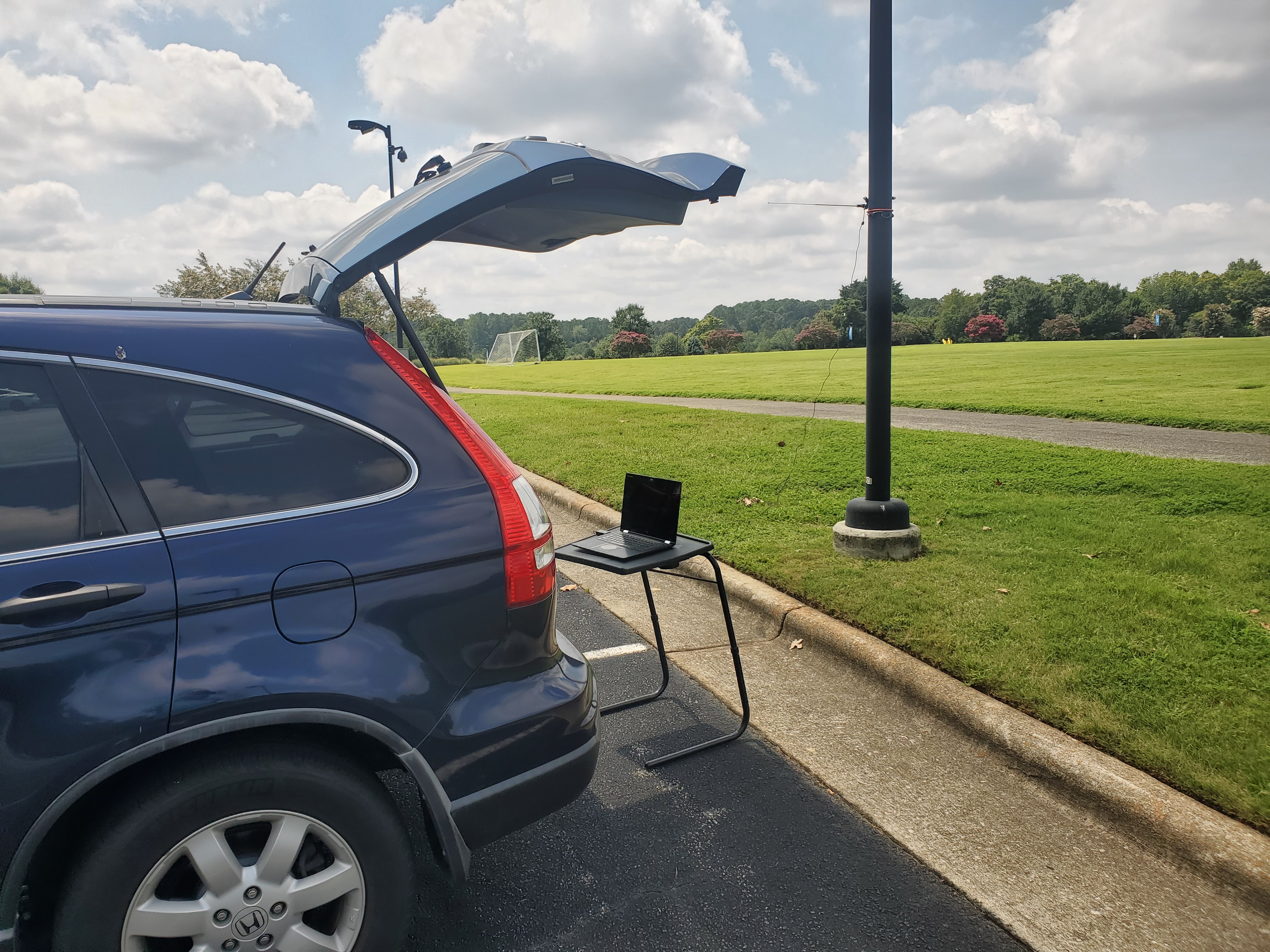
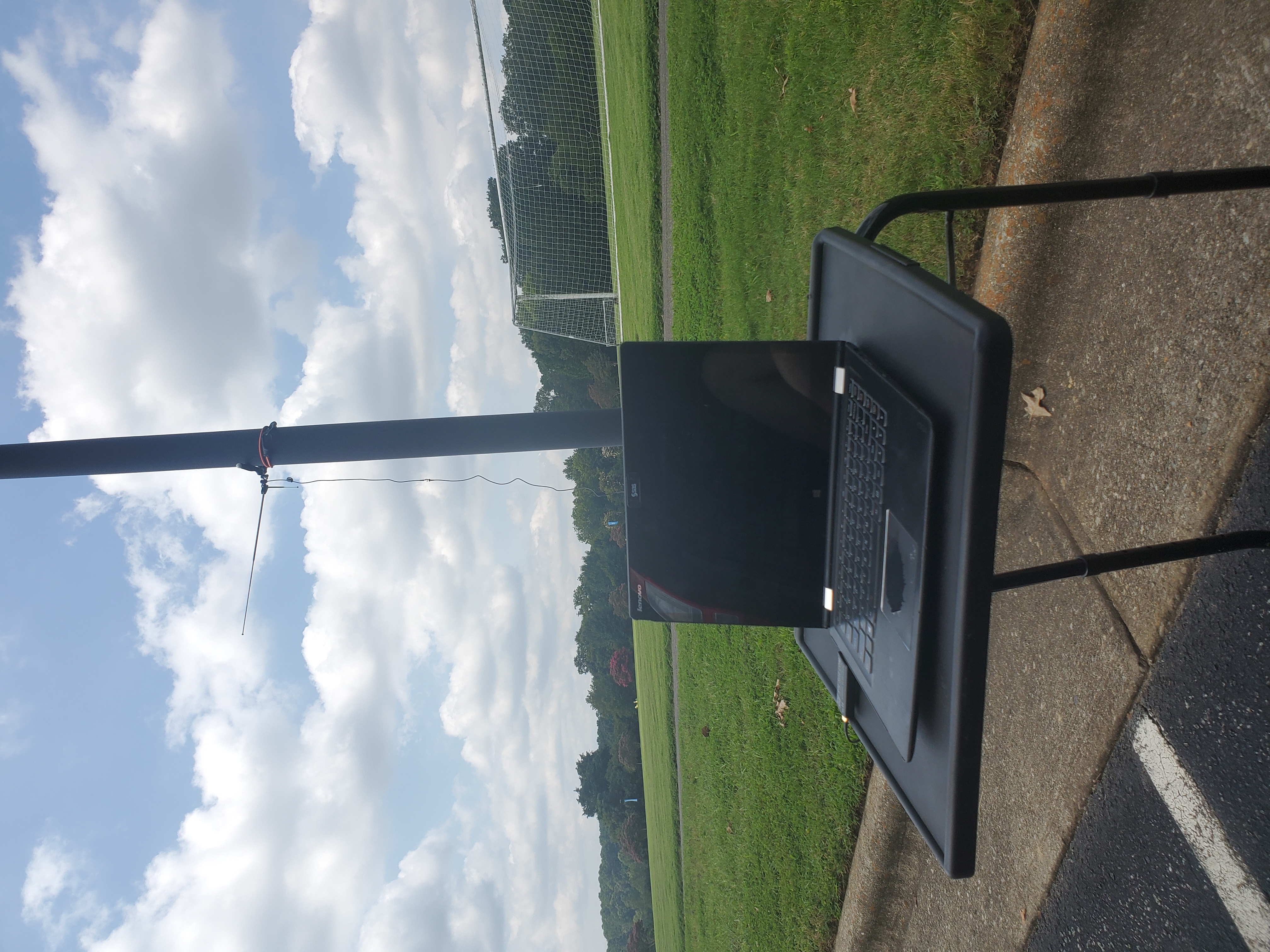
With that in mind, I normally take my laptop, dongle, and dinky little antenna out to a field. My antenna is the one from the RTL-SDR kit. It’s basically the old TV “rabit ear” antenna. Configured in a V in a parallel plane to the ground, it catches enough signal to tell what’s going on.
This is what my setup normally looks when deployed in the field.
Slow-scan television is one of those things that I learned about long ago and knew that I had to try whenever I got my license. Slow-scan TV is a way to send still images over the radio. It’s like television of yesteryear, but uses much less bandwidth. (The television mode is actually called Fast-scan television.)
The problem with SSTV is that it’s much less common than the audio modes. Fortunately, the International Space Station will ocassionally do SSTV experiments. They normally last around a week so that you have several opportunities to catch an image.
I had one good pass that aligned with my free time on the weekend. Here’s what I got.
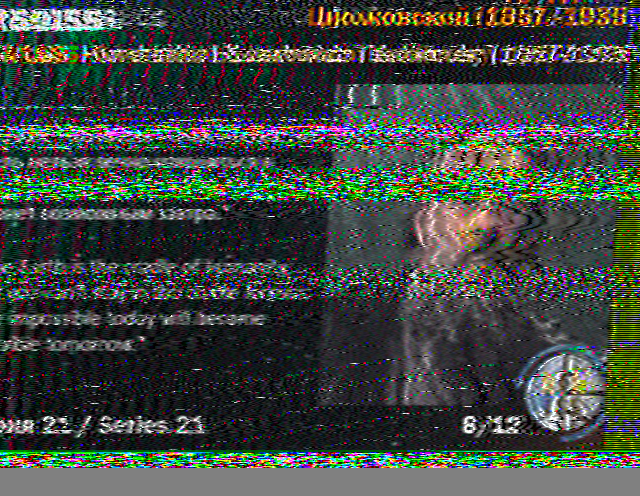
This is… not a great image. For context, you can see what other people submitted by going to this website and selecting Expedition 72 - ARISS Series 21 SSTV Experiment. Part of the problem is in the recording itself. You can hear noise. Part of the problem is that I was having trouble with the software. It wouldn’t read the file directly. However, it could also create an image from the sound. So, I played the recording from speaker to microphone to generate an image.
Hey, I was desperate. There was a deadline to submit your image and I really wanted a QSL card from the ISS. Fortunately, there’s enough image to tell that I got something and not just noise. ARISS logged my attempt and I eventually got my QSL card :)
This was actually the first transmission I ever received.1 I’m not entirely sure which satellite it was - the tracker listed it as NOAA-19 and SatDump listed it as NOAA-15. I was so excited about the image that I never corroborated it.
The story goes like this. I had gotten my SDR earlier in the week. Saturday was going to be my big opportunity to play with it. I had few expectations. I had really expected this to be something with a huge learning curve and a lot of troubleshooting. That’s how these kinds of projects normally go. I got to the field and set up 20-30 minutes before the pass was projected. A few seconds after the satellite was projected to crest the horizon, sounds start breaking the noise. It’s a rhythmic pulse that alternates betwee an old-timey cash register and a ticking clock. Tick, ca-ching. Tok, ca-ching.
There’s no image or anything - that comes later with the secret decoder ring. I start the recording and hope. “Gee, it still sounds awful noisy.”
About 6 minutes later, the noise starts overtaking the signal. Right on time with the satellite tracker’s projected time for the satellite to dip below the horizon. I pack up, grab lunch, and head home to decode the recording. When I get pack and finally run SatDump, I’m stunned. The first thing I ever pulled from a satellite is beautiful.
Hello, Michigan!

There are several other images that were decoded as well. They had much more technical information packed into them. I’d like to learn more about the images and the instruments that took them. But to get a beautiful picture like that on my first shot. I’ll be chasing that high for a long time.
There’s still a lot that I want to do in ham radio. I feel like I’m finding a niche here with software-defined radio, but there’s a deep well of other topics to look into. A ham license really is a license to experiment with the radio spectrum.
I should note, that you don’t need a license to receive, but only to transmit. Get yourself an RTL-SDR and try it out for yourself!
Aside from tuning in to 99.9 The Fan to ensure that the SDR was working.↩︎